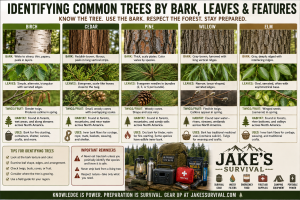
When you’re in the wilderness, trees provide much more than shade and firewood. Depending on the species, tree bark can be useful for cordage, shelter, fire starting, containers, food, medicine, and other traditional purposes.
Learning how to recognize useful trees can be another valuable skill to add to your survival knowledge. At JakesSurvival.com, we believe preparedness is about combining the right gear with practical knowledge.
Birch bark has been used by people for centuries because it is lightweight, flexible, and naturally water-resistant.
Depending on the species, birch bark has traditionally been used for:
Birch bark can be particularly useful as a fire starter because its natural oils can help it ignite even when conditions aren’t ideal.
Never strip bark from a living tree unnecessarily. Look for naturally fallen bark when possible.
Cedar has long been valued by Indigenous peoples and wilderness craftsmen. The inner bark fibers of some cedar species can be processed into strong, flexible material.
Traditional uses have included:
The exact properties vary between tree species, so proper identification is important.
Pine trees are widespread across North America, making them useful trees to learn about.
Dry pine bark can be useful as tinder, while the bark and other parts of certain pine species have been used traditionally for food and other purposes.
Some pine species have edible inner bark, but correct identification is essential. Not every tree that looks like a pine should be consumed.
Willow trees are commonly found near rivers, streams, and wetlands.
Willow bark has a long history of traditional use, and willow contains salicin, a compound related to aspirin. However, natural willow preparations aren’t equivalent to properly dosed medications and can have risks and interactions.
Willow branches have also traditionally been used for:
Some trees have fibrous inner bark that can be processed for traditional cordage, weaving, and other purposes.
Learning which local trees have useful fibers can be particularly valuable if you’re practicing wilderness skills.
Again, tree identification comes first. Some species can look surprisingly similar.
Tree bark can also play an important role in basic wilderness skills.
Large pieces of naturally fallen bark can sometimes provide material for:
When collecting material, avoid damaging living trees whenever possible. Responsible outdoor skills help preserve the environment for everyone.
One of the biggest mistakes in survival foraging is assuming that something natural must be safe to eat.
Never consume tree bark unless you have positively identified the species and know that the specific part is edible and properly prepared.
Some trees can be toxic, and even traditionally edible materials may not be appropriate for everyone.
A good field guide specific to your region can be an invaluable addition to your outdoor education.
Knowing how to use natural resources is valuable, but you shouldn’t plan on relying entirely on nature during an emergency.
That’s where preparation comes in.
At JakesSurvival.com, you can find survival and emergency supplies including:
Having reliable equipment means you can use your wilderness knowledge as a backup rather than your only option.
The trees around your home may be different from those found in another part of the country. That’s why learning your local tree species is one of the best ways to develop practical wilderness knowledge.
Start by learning to identify a few common trees. Study their bark, leaves, branches, seeds, and overall shape. Then learn what each species has traditionally been used for.
Over time, you’ll begin seeing the forest differently—not simply as a collection of trees, but as a collection of potential resources.
From birch and cedar to pine and willow, tree bark has served people in countless ways throughout history. It can provide materials for fire, shelter, cordage, crafts, and, in the case of certain properly identified species, traditional food or medicinal uses.
But survival knowledge requires responsibility. Identify before you use, avoid unnecessary damage to living trees, and never consume an unknown plant or bark.
Preparedness is about being ready before you need to be.
Visit JakesSurvival.com for water filtration, emergency food, first aid supplies, camping equipment, portable power, and survival gear to complement your outdoor skills.
Learn from nature. Respect the wilderness. Stay prepared with JakesSurvival.com.