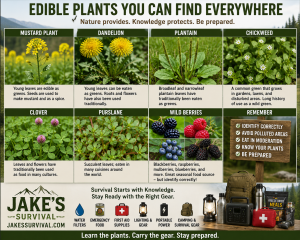
When you’re walking through a field, hiking a trail, or exploring the outdoors, you may be surrounded by plants that have been used as food for generations. One of the most interesting examples is the mustard plant. Mustard species grow in many parts of the world and have long been valued for their flavorful, nutritious leaves and seeds.
At JakesSurvival.com, we believe that preparedness isn’t just about having the right equipment. It’s also about learning skills that can help you understand and navigate the natural world.
Mustard plants belong to the Brassicaceae family, which includes familiar vegetables such as broccoli, cabbage, kale, turnips, and radishes.
Several mustard species have been cultivated and eaten around the world. Their young leaves can be used as greens, while their seeds are used as a spice and to make mustard.
Wild mustard can sometimes be found growing along roadsides, fields, disturbed soil, and open areas. However, location matters. Plants growing beside heavily traveled roads or areas treated with chemicals may be contaminated.
And before eating any wild plant, make absolutely sure you have identified it correctly.
Mustard isn’t the only potentially useful plant found across many regions. Depending on your location and the season, you may encounter several familiar wild edibles.
Dandelions are among the most recognizable plants in the world. Their young leaves are commonly used as greens, and their roots and flowers have also been used traditionally.
Their distinctive yellow flowers make them relatively easy to recognize—but proper identification is still important.
Not the banana-like fruit—broadleaf and narrowleaf plantain are common weeds found in lawns, fields, trails, and disturbed ground.
Young leaves have traditionally been eaten as greens in some cultures.
Chickweed is a small, low-growing plant that can appear in gardens, lawns, and disturbed areas. It has a long history of use as a wild green.
As with any wild plant, correct identification is essential.
Several types of clover are widespread across North America and other parts of the world. Clover leaves and flowers have traditionally been used as food, although preparation and suitability can vary by species.
Purslane is another plant that can be surprisingly common in gardens and disturbed areas. It has succulent leaves and has been eaten in many cuisines around the world.
Depending on where you live, you may encounter blackberries, raspberries, mulberries, blueberries, or other edible berries.
Berries can be an excellent seasonal food source—but never assume that a berry is edible simply because birds or other animals are eating it.
One of the most important rules of wild-food foraging is simple:
Never eat a wild plant unless you can positively identify it.
Some edible plants have poisonous look-alikes. Others can cause problems if eaten in large quantities or prepared incorrectly.
It’s also important to consider where the plant is growing. Avoid harvesting plants from areas that may have been sprayed with pesticides, exposed to pollutants, or contaminated by animals.
A regional field guide or instruction from a knowledgeable local forager can be invaluable.
Learning about wild edible plants can be an excellent survival skill, but it shouldn’t replace proper preparation.
Wild foods are seasonal and unpredictable. A much better strategy is to combine knowledge, stored food, water, and reliable survival equipment.
At JakesSurvival.com, you can find survival and preparedness supplies to help you prepare for emergencies and outdoor adventures, including:
Mustard plants are a great example of how something that may look like an ordinary weed can have a long history as a food source.
Learning to recognize mustard, dandelions, plantain, chickweed, purslane, clover, and locally available berries can expand your knowledge of the natural world and give you another useful skill to add to your preparedness toolbox.
But the best survival plan combines knowledge with preparation.
Visit JakesSurvival.com to find the gear and supplies you need to stay ready—whether you’re preparing for an emergency, heading into the wilderness, or simply learning more about the outdoors.
Learn the plants. Learn the skills. Carry the right gear. Stay prepared.